Friday, September 7, 2012

Verbal Flirting - Opening Lines

Opening lines
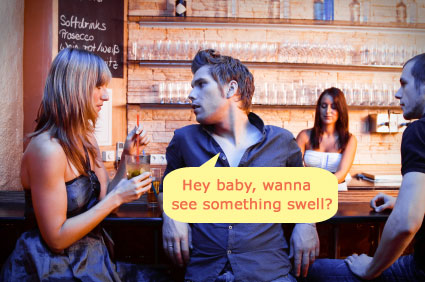
When the subject of flirting comes up, most people seem to be obsessed with the issue of 'opening lines' or 'chat-up lines'. Men talk about lines that work and lines that have failed; women laugh about men's use of hackneyed or awkward opening lines, and all of us, whether we admit it or not, would like to find the perfect, original, creative way to strike up a conversation with someone we find attractive.

The answer, perhaps surprisingly, is that your opening line is really not very important, and all this striving for originality and wit is a wasted effort. The fact is that conversational 'openers' are rarely original, witty or elegant, and no-one expects them to be so. The best 'openers' are, quite simply, those which can easily be recognised as 'openers' – as attempts to start a conversation.

The traditional comment on the weather ("Nice day, isn't it?" or "Doesn't feel much like summer, eh?", etc.) will do just fine, as everyone knows that it is a conversation-starter. The fact that these comments are phrased as questions, or with a rising 'interrogative' intonation, does not mean that the speaker is unsure about the quality of the weather and requires confirmation: it means that the speaker is inviting a response in order to start a conversation.

In Britain, it is universally understood that such weather-comments have nothing to do with the weather, and they are universally accepted as conversation-starters. Saying "Lovely day, isn't it?" (or a rainy-day equivalent) is the British way of saying "I'd like to talk to you; will you talk to me?"

A friendly response , including positive body language, means "Yes, I'll talk to you"; a monosyllabic response (accompanied by body-language signalling lack of interest) means "No, I don't want to talk to you", and no verbal response at all, with body language signalling annoyance or dislike, means "Shut up and go away".
If you are indoors – say at a party or in a bar – and nowhere near a window, some equally innocuous general comment on your surroundings ("Bit crowded, isn't it?", "Not very lively here tonight, eh?") or on the food, drink, music, etc., will serve much the same purpose as the conventional weather-comment. The words are really quite unimportant, and there is no point in striving to be witty or amusing: just make a vague, impersonal comment, either phrased as a question or with a rising intonation as though you were asking a question.

This formula – the impersonal interrogative comment – has evolved as the standard method of initiating conversation with strangers because it is extremely effective. The non-personal nature of the comment makes it unthreatening and non-intrusive; the interrogative (questioning) tone or 'isn't it?' ending invites a response, but is not as demanding as a direct or open question.

There is a big difference between an interrogative comment such as "Terrible weather, eh?" and a direct, open question such as "What do you think of this weather?". The direct question demands and requires a reply, the interrogative comment allows the other person to respond minimally, or not respond at all, if he or she does not wish to talk to you.

In some social contexts – such as those involving sports, hobbies, learning, business or other specific activities – the assumption of shared interests makes initiating conversation much easier, as your opening line can refer to some aspect of the activity in question. In some such contexts, there may even be a ritual procedure to follow for initiating conversation with a stranger. At the races, for example, anyone can ask anyone "What's your tip for the next?" or "What do you fancy in the 3.30?", a ritual opening which effectively eliminates all the usual awkwardness of approaching a stranger.

Unless the context you are in provides such a convenient ritual, use the IIC (Impersonal Interrogative Comment) formula. This formula can be adapted to almost any situation or occasion. Just make a general, impersonal comment on some aspect of the event, activity, circumstances or surroundings, with a rising intonation or 'isn't it?' type of ending. Your target will recognise this as a conversation-starter, and his or her response will tell you immediately whether or not it is welcomed.

There are of course degrees of positive and negative response to an IIC. The elements you need to listen for are length, personalising and questioning. As a general rule, the longer the response, the better. If your target responds to your comment with a reply of the same length or longer, this is a good sign. A personalised response, i.e. one including the word 'I' (as in, for example, "Yes, I love this weather") is even more positive. A personalised response ending in a question or interrogative (rising) intonation (as in "I thought it was supposed to clear up by this afternoon?") is even better, and a personalised response involving a personalised question, i.e. a response including the words 'I' and 'you', is the most positive of all.

So, if you say "Nice day, isn't it?" and your target replies "Yes, I was getting so tired of all that rain, weren't you?", you are definitely in with a chance. Note that there is nothing original, witty or clever about the above exchange. You may even be inclined to dismiss it as polite, boring and insignificant. In fact, a great deal of vital social information has been exchanged. The opener has been recognised as a friendly invitation to a conversation, the invitation has been accepted, the target has revealed something about him/herself, expressed interest in you, and even suggested that you might have something in common!

The biggest mistake most people make with opening lines is to try to start a flirtation, rather than simply trying to start a conversation. If you think about your opening line as initiating a conversation, rather than starting a flirtation, use the IIC formula and pay close attention to the verbal and non-verbal response, you cannot go wrong. Even if your target does not find you attractive and declines your invitation to talk, you will avoid causing offence and you will avoid the humiliation of a direct rejection.

Let's build up to Small Talk now!
Love, 
ALPHA

Thursday, September 6, 2012

Verbal Flirting

Verbal flirting
Although your target's initial impressions of you will depend more on your appearance, body language and voice than on what you actually say, successful flirting also requires good conversation skills.

The 'art' of verbal flirting is really just a matter of knowing the rules of conversation, the unwritten laws of etiquette governing talking and listening. The best and most enjoyable conversations may seem entirely spontaneous, but the people involved are still obeying rules. The difference is that they are following the rules automatically, without consciously trying, just as skilled, experienced drivers do not have think about changing gears. But understanding how the rules of conversation work – like learning how and when to change gears – will help you to converse more fluently, and flirt more successfully.

Studies have shown that women tend to be more skilled at informal social conversation than men, both because they are naturally more socially sensitive, and because they have better verbal/communication skills. (Men make up for this with superior visual-spatial abilities, but these are not much help in verbal flirting.) Men can, of course, easily learn to be as skilled in the art of conversation as women – it is only a matter of following a few simple rules – but some do not take the trouble to learn, or may be unaware of their deficiencies in this area. Those males who do take the trouble to improve their conversation skills  have a definite advantage in the flirting stakes.

Come back tomorrow for the beginnings of Verbal Flirting ;) 
Love, 
ALPHA

Wednesday, September 5, 2012

Non-Verbal Flirting - Vocal Signals

Vocal signals
You may be surprised to see this heading in the 'Non-verbal flirting' section, but 'verbal' means 'words' and vocal signals such as tone of voice, pitch, volume, speed of speech, etc. are like body-language in that they are not about what you say, the words you use, but about how you say it.

We noted at the beginning of this 'non-verbal' section that people's first impressions of you are based 55% on your appearance and body language, 38% on your style of speaking and only 7% on what you actually say. In other words, body-language may be your most important 'flirting tool', but vocal signals come a very close second. The more you think about that 38%, the more concerned you will be to ensure that your vocal signals make the best possible impression. An ability to 'read' the vocal signals of the person you are flirting with will also help you to find out how he or she really feels about you.

Attraction and interest, for example, are communicated much more by the tone of voice than by what is actually said. Depending on the tone, volume, speed and pitch, even a simple phrase such as "Good evening" can convey anything from "Wow, you're gorgeous" to "I find you totally uninteresting and I'm looking for an excuse to get away from you as quickly as possible".

If your target gives you a deep-toned, low pitched, slow, drawn-out "Good evening", with a slight rising intonation at the end, as though asking a question, this is probably an indication of attraction or at least interest. If you get a short, high-pitched, clipped "Good evening", or a monotone, expressionless version, your target is probably not interested in you.

Once you are in conversation, remember that the intonation of even a single word can communicate an immense variety of emotions and meanings. As an experiment, try practising variations in your intonation of the one-word response "Yeah", and you will find that you can communicate anything from enthusiastic agreement to grudging acceptance to varying degrees of scepticism to total disbelief.

If you speak in a monotone, with little variation in pitch, pace or tone of voice, you will be perceived as boring and dull, even if what you are saying is truly fascinating or exceptionally amusing. Loud volume, a booming tone and too much variation in pitch will make you seem overbearing. Speak too quietly or too slowly and you will seem submissive or even depressed. Aim for moderation in volume and tone, with enough variation in pitch and pace to hold your companion's interest.

Also remember that a rising or falling intonation, especially when accompanied by a drop in volume, is a 'turn-yielding cue', whereby speakers signal that they have finished what they are saying and are ready to listen to the other person. When you hear these vocal signals, your companion is probably indicating that it is your turn to speak. When your companion hears these signals, he or she may well assume that you are 'yielding' the floor. If you frequently end sentences on a rising or falling intonation, with a drop in volume, and then carry on without allowing your companion to speak, he or she will become frustrated. Taking your turn when your companion has not given any vocal 'turn-yielding cues', even if he or she has finished a sentence, will be perceived as interruption, and is equally irritating.

Tuesday, September 4, 2012

Non-Verbal Flirting - Touch

Touch
Touching is a powerful, subtle and complex form of communication. In social situations, the language of touch can be used to convey a surprising variety of messages. Different touches can be used to express agreement, affection, affiliation or attraction; to offer support; to emphasise a point; to call for attention or participation; to guide and direct; to greet; to congratulate; to establish or reinforce power-relations and to negotiate levels of intimacy.

Even the most fleeting touch can have a dramatic influence on our perceptions and relationships. Experiments have shown that even a light, brief touch on the arm during a brief social encounter between strangers has both immediate and lasting positive effects. Polite requests for help or directions, for example, produced much more positive results when accompanied by a light touch on the arm.

When flirting, it is therefore important to remember that the language of touch, if used correctly, can help to advance the relationship, but that inappropriate use of this powerful tool could ruin your chances forever.

Although there are considerable differences between cultures in the levels of touching that are socially acceptable, and different personalities welcome different levels of touching, we can provide a few basic rules-of-thumb for first encounters with strangers of the opposite sex.

The first rule, for both sexes, is: touch, but be careful. Women are much less comfortable about being touched by an opposite-sex stranger than men, so men should take care to avoid any touches which may seem threatening or over-familiar. Men are inclined to interpret women's friendly gestures as sexual invitations, so women should be equally careful to avoid giving misleading signals with over-familiar touches.

This does not mean 'don't touch', as appropriate touching will have positive benefits, but touching should initially be restricted to universally acceptable areas and levels. As a general rule, the arm is the safest place to touch an opposite-sex stranger. (Back pats are equally non-sexual, but are often perceived as patronising or overbearing.) A brief, light touch on the arm, to draw attention, express support or emphasise a point, is likely to be acceptable and to enhance your companion's positive feelings towards you.

If even this most innocuous of touches produces a negative reaction – such as pulling the arm away, increasing distance, frowning, turning away or other expressions of displeasure or anxiety – you might as well give up now. Unless your companion is exceptionally shy and reserved, negative reactions to a simple arm-touch probably indicate dislike or distrust.

If your companion finds you likeable or attractive, a brief arm-touch should prompt some reciprocal increase in intimacy. This may not be as obvious as a return of your arm-touch, but watch for other positive body-language signals, such as increased eye-contact, moving closer to you, more open posture or postural echo, more smiling, etc. Your arm-touch may even prompt an increase in verbal intimacy, so listen for any disclosure of personal information, or more personal questions.

If you see or hear signs of a positive reaction to your arm-touch, you can, after a reasonable interval, try another arm-touch, this time slightly less fleeting. If this results in a further escalation of verbal or non-verbal intimacy from your companion, you might consider moving to the next stage: a hand-touch.

Remember that a hand-touch, unless it is the conventional handshake of greeting or parting, is much more personal than an arm-touch. By touching your companion's hand, you are opening negotiations towards a higher degree of intimacy, so keep it light and brief: a question, not an order.

A negative reaction to your hand-touch, such as the non-verbal signals of displeasure or anxiety mentioned above, does not necessarily mean that your companion dislikes you, but it is a clear indication that your attempt to advance to the next level of intimacy is either premature or unwelcome. A very positive reaction, involving a significant increase in verbal or non-verbal intimacy, can be taken as permission to try another hand-touch at an appropriate moment.

Highly positive reactions to a second hand-touch – such as a definite and unambiguous attempt to move closer to you, reciprocal arm- and hand-touching, along with significantly more personal questions, more disclosure of personal information and more expression of emotion – can be taken as permission to proceed, with caution, to a higher level of intimacy. The next stages might involve a hand-squeeze or hand-hold, repeated twice before moving on to an arm over the shoulders, or perhaps a brief knee-touch. (Males should note, however, that positive reactions to any of these touches can not be taken as permission to grope.)

You will have noticed that we advise performing each touch two times before progressing to the next level. This is because repeating the same touch, perhaps with a slightly longer duration, allows you to check that reactions are still positive, that you were not mistaken in your judgement that the touch was acceptable. The repetition also tells your companion that the first touch was not accidental or unconscious, that you are consciously negotiating for an increase in intimacy. Repeating the same touch before moving to the next level is a non-verbal way of saying "Are you sure?".

Ok, ok, ok, let's move more into Verbal Flirting now!
Love, 
ALPHA

Monday, September 3, 2012

Non-Verbal Flirting - Facial Expression


Facial Expression
An ability to 'read' and interpret the facial expressions of your partner will improve your chances of successful flirting, as will awareness of what you are signalling with your own expressions.

Some expressions can be effective even from a distance, as in the 'across a crowded room' encounter with a stranger. The 'eyebrow-flash', for example, which involves raising the eyebrows very briefly – for about one-sixth of a second – is used almost universally as a long-distance greeting signal. When you see someone you know, but are not near enough to speak, the eyebrow-flash shows that you have noticed and recognised them.

We all use this non-verbal "Hello!" in situations where we cannot use the verbal equivalent, either because of distance or social convention. Watch a video of Andrew and Fergie's wedding, for example, and you will see that Fergie performs frequent eyebrow-flashes as she walks down the aisle. Social etiquette does not allow a bride to call out cheery greetings to her friends and relations during the ceremony, but the highly sociable Fergie is clearly unable to refrain from signalling the same greetings with her eyebrows.

If you are desperate to attract the attention of an attractive stranger across a crowded party, you could try an eyebrow-flash. This should make your target think that you must be a friend or acquaintance, even though he or she does not recognise you. When you approach, your target may thus already be wondering who you are. You can, if you are skilful, use this confusion to initiate a lively discussion about where you might have met before. Such conversations inevitably centre on possible shared interests or friends or habits, and invariably involve mutual disclosure of at least some personal information. As you will learn from the 'Verbal flirting' sections of this Guide, these are essential ingredients of successful flirting. So, assuming your target finds you attractive, an eyebrow-flash with appropriate follow-up could leapfrog you into instant intimacy.

Two warnings are necessary here: 1) If your target does not find you attractive, the eyebrow-flash strategy may backfire, as the confusion over whether or not you already know each other will be experienced as unpleasant and annoying, rather than amusing. 2) Do not use the eyebrow-flash in Japan, where it has definite sexual connotations and is therefore never used as a greeting signal.

If your target is attracted to you, this may be more evident in facial expressions than in words. Studies have found that women are generally better than men at reading these expressions, but that both sexes have equal difficulty in seeing through people's expressions when they are controlling their faces to hide their real feelings.

The problem is that although faces do express genuine feelings, any facial expression that occurs naturally can also be produced artificially for a social purpose. Smiles and frowns, to take the most obvious examples, can be spontaneous expressions of happiness or anger, but they can also be manufactured as deliberate signals, such as frowning to indicate doubt or displeasure, smiling to signal approval or agreement, etc. Feelings can also be hidden under a 'social' smile, a 'stiff upper lip' or a blank, 'inscrutable' expression.

Despite this potential for 'deceit', we rely more on facial expressions than on any other aspect of body language. In conversation, we watch our companions' faces rather than their hands or feet, and rely on their facial signals to tell us what effect we are having, and how to interpret what they say. Although people are better at controlling their facial expressions than other aspects of body language, there is still some 'leakage', and the following clues will help you to detect insincerity.

Let's say your target smiles at you. How do you know whether this smile is spontaneous or manufactured? There are four ways of telling the difference. First, spontaneous smiles produce characteristic wrinkles around the eyes, which will not appear if your target is 'forcing' a smile out of politeness. Second, 'forced' or 'social' smiles tend to be asymmetrical (stronger on the left side of the face in right-handed people and on the right side of the face in left-handed people).The third clue to insincerity is in the timing of the smile: unspontaneous smiles tend to occur at socially inappropriate moments in the conversation (e.g. a few seconds after you have made a funny remark, rather than immediately). Finally, there is a clue in the duration of the smile, as a manufactured smile tends to be held for longer (what is often called a 'fixed' smile) and then to fade in an irregular way.

When observing your target's facial expressions, it is important to remember that although an expressive face – showing amusement, surprise, agreement etc. at the appropriate moments – may indicate that your target returns your interest, people do naturally differ in their degree and style of emotional expression. Women naturally tend to smile more than men, for example, and to show emotions more clearly in their facial expressions.

You are also likely to interpret expressions differently depending on who is making them. Experiments have shown that people may read the same expression as 'fear' when they see it on a female face, but as 'anger' when it appears on male face. There are also cultural and even regional differences in the amount of emotion people express with their faces. Oriental people are more likely than Westerners to hide their emotions under a 'blank' expression or a smile, for example, and American researchers have found that in the US, Notherners smile less than people from the South.

If an attractive stranger smiles at you, it could be that he or she finds you attractive, but he or she could also be an outgoing, sociable person from a culture or region in which smiling is commonplace and not particularly meaningful.

These factors must also be taken into account when considering the effect of your own facial expressions. People tend to be put off by levels of expressiveness that are considerably higher or lower than what they are used to, so it could help to try to 'match' the amount of emotion you express with your face to that of your target.

As a general rule, however, your face should be constantly informative during a flirtatious conversation. Unexpressiveness – a blank, unchanging face – will be interpreted as lack of interest when you are listening and an absence of facial emphasis when you are speaking will be disturbing and off-putting. You need to show interest and comprehension when listening, and to promote interest and comprehension when speaking, through facial signals such as eyebrows raised to display surprise, as a question mark or for emphasis; the corners of the mouth turning up in amusement; nodding to indicate agreement; frowning in puzzlement; smiling to show approval, or to indicate that what you are saying should not be taken too seriously, and so on.

Fortunately, most of these facial signals are habitual, and do not have to be consciously manufactured, but some awareness of your facial expressions can help you to monitor their effect and make minor adjustments to put your target more at ease, for example, or hold his or her attention, or increase the level of intimacy.

Finally, remember that your target is unlikely to be scrutinising you for tiny signs of insincerity, so a 'social' smile will be infinitely more attractive than no smile at all.

TOUCH TOUCH TOUCH - NEXT!
Love, 
ALPHA